

Achieving Higher Accuracy than the Widely Used B3LYP-D3(BJ) with Minimal Training Data
- We are developing a machine learning-based approach to construct exchange-correlation
(XC)functionals, which govern the accuracy of density functional theory(DFT). - Trained on just
3,079reactions from public datasets, our43,000-parameter model achieved lower errors thanB3LYP-D3(BJ)across a subset of the standard molecular benchmarkGMTKN55. - Because it contains no exact exchange term, it eliminates the expensive exact exchange calculations required by hybrid functionals.
Background: DFT Accuracy Depends on the XC Functional
Density functional theory is the most widely used electronic structure method for simulating materials and molecules. Its accuracy is determined by the quality of the approximation known as the exchange-correlation (XC) functional. Historically, higher-accuracy functionals have required significantly greater computational cost, making the pursuit of methods that are both fast and accurate a longstanding challenge. In recent years, research into building XC functionals directly via machine learning—using high-accuracy quantum chemical calculations as training data—has been advancing worldwide.
Key Features of GraphicalXC
We are developing GraphicalXC by applying the deep learning technologies cultivated through our proprietary orbital-free DFT software, Advance/OF-DFT, to XC functionals.
- Informed by Surrounding Electron Density: The energy at each point is determined not only by the local value at that point, but also by the surrounding electron density distribution. We implemented convolution operations that gather neighborhood information on molecular integration grids using proprietary high-speed computational kernels (
C++andGPU). - Compact Model Size: The model consists of approximately
43,000parameters. By multiplying the exchange-correlation terms of the local density approximation and van der Waals interaction terms by learned correction factors, the model serves as a physically meaningful functional even before training. - No Exact Exchange Term: Unlike hybrid functionals such as
B3LYP, it requires no exact exchange calculations. - Compatible with Existing Codes: It integrates with the open-source quantum chemistry package
PySCF, enabling self-consistent field (SCF) calculations through the same workflow as standardDFT. - Joint Training on Energy and Potential: By imposing training conditions not only on energy values but also on their derivatives (potentials), the model ensures numerical stability during self-consistent calculations.
Validation Results
Only publicly available, high-accuracy computational datasets were used as training data (Table 1)—a substantially smaller dataset than those used in prior machine-learned functional studies.
| Category | Source | Reactions |
|---|---|---|
| Atomization Energy | MSR-ACC/TAE25 | 1,600 |
| Non-covalent Interactions | DES370K | 679 |
| Reaction Barriers | RDB7 | 800 |
| Total | 3,079 |
The trained model was evaluated on a portion of GMTKN55, a standard benchmark covering molecular thermochemistry, reaction kinetics, and non-covalent interactions (Figure 1). Across all 9 evaluated subsets, our model achieved errors equal to or lower than those of B3LYP-D3(BJ) computed under identical conditions. The composite metric across 5 subsets (293 reactions), denoted as partial WTMAD-2, was 5.35 kcal/mol, outperforming B3LYP-D3(BJ) at 6.59 kcal/mol. Furthermore, adding reaction barrier data to the training set reduced errors by more than half across 3 barrier-related subsets, confirming that expanding the training data directly translates into higher accuracy.
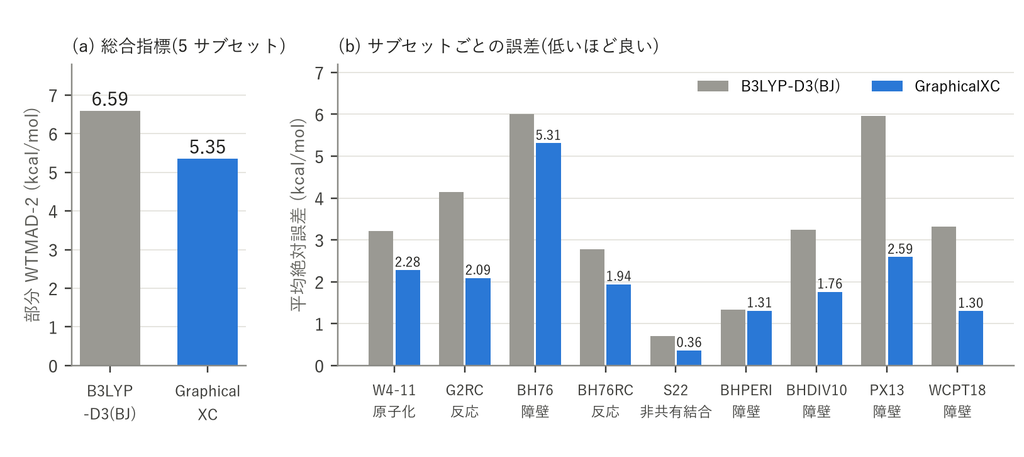
B3LYP-D3(BJ) on a subset of GMTKN55. (a) Composite metric across 5 subsets (293 reactions). (b) Mean absolute error (MAE) for each subset. Self-consistent calculations performed with the def2-TZVP basis set.*Note: Evaluations were conducted on 9 out of the 55 subsets in GMTKN55. All calculations used the def2-TZVP basis set, including B3LYP-D3(BJ) under identical conditions. A tendency to underestimate barrier heights remains for reaction barriers involving open-shell transition states (BH76).
Future Outlook
These results represent a validation stage using a small volume of public data, and further improvements in accuracy are expected as we expand the training dataset. We will continue developing this technology with the goal of approaching chemical accuracy without the computational overhead of exact exchange—breaking through the traditional trade-off between speed and accuracy. In parallel, we are exploring tailored workflows in which the functional is fine-tuned using dedicated training data suited to specific target materials or phenomena.
Our Initiatives
AdvanceSoft Corporation is dedicated to developing first-principles calculation software as well as providing contract analysis and custom software development services based on these technologies. We are also actively advancing technologies that integrate machine learning with electronic structure calculations. For inquiries regarding this technology, please contact our support desk.
GlossaryB3LYP-D3(BJ): A widely used hybrid functional for molecular calculations supplemented with empirical dispersion corrections.GMTKN55: A benchmark suite covering main-group thermochemistry, kinetics, and non-covalent interactions.WTMAD-2: The weighted total mean absolute deviation across subsets used in GMTKN55. The value reported in this article is a partial value computed over 5 subsets only and cannot be directly compared with full-benchmark values in the literature.PySCF, MSR-ACC/TAE25, DES370K, RDB7, and GMTKN55 are publicly available software packages and datasets.